Trainer Initiative

The demand for LightAct expertise is high, and our Trainer Initiative is designed to support and generously reward professionals like you. 

If you are a Certified LightAct Operator, apply today to become a Certified LightAct Trainer across four key levels: Essentials, Advanced, Tracking, and Projection.

What is the Advantage?

We fully equip you for success, providing complete curriculums, exercises, project files, and presentations.

The best part? For every successful training session with five or more participants, you receive a free 6-month 3x4K Partner license that can be used on your own commercial projects!

Take control by setting your own training fees and significantly boosting your professional profile in the global LightAct community.

Big Shows, Fast Workflows

Interview with Rightway Audio Consultants

We are pleased to share a new video interview featuring our long-standing partner in China, Rightway Audio Consultants.

In this insightful discussion, representatives from Rightway Audio Consultants offer their perspective on the LightAct platform, reflecting on the evolution of our collaborative partnership and sharing their vision for where they see LightAct’s role developing in the Greater China market in the future.

Discover how this key partnership continues to drive innovation in high-end audiovisual solutions for live events and fixed installations across the region.

Learn more about our partner and their services by visiting the Rightway Audio Consultants website below.

Big Shows, Fast Workflows

FirstLight Initiative

We are very excited to announce the launch of a new support initiative: FirstLight Initiative!

This program is specifically aimed at assisting studios, freelancers, and agencies in successfully creating their very first show using LightAct. We understand that switching media server solutions can be a significant decision, and we want to make that transition as seamless as possible. With FirstLight, we hope to empower creative professionals to experience the flexibility and power of LightAct firsthand.

What is the Advantage?

If you are a studio, a freelance operator, or an agency with extensive experience in live events, and you are currently considering switching to LightAct from other media server solutions, the FirstLight Initiative offers a compelling benefit. You can receive one or several Free 4 x 4K Partner licenses for a few months to cover the duration of your initial projects with LightAct.

This means you get to use our powerful software on your crucial first shows without a substantial up-front license cost.

Big Shows, Fast Workflows

Interview with Show Sage

"LightAct has a strong vision for the product and is extremely responsive to customer needs."

Jim Testa

Show Sage

We had a chat with Jim Testa, Crystal Lee and Connor Wright from Chicago based AV distributor Show Sage.

They have been working with LightAct for more than a year now and had a lot of interestings things to say about their work, media server technologies on the market and what they are up to.

Tell us about Show Sage

Jim Testa: Show Sage was founded in early 2002 as the North American distributor for Dataton’s new media server product, WATCHOUT. Over the years, the company has grown and evolved from being focused solely on WATCHOUT to being a trusted advisor for multiple media server solutions and AV control systems. Today, the company serves hundreds of customers and has provided media server and control system technology for applications in theme parks, theatres, cruise ships, visitor centers, corporate meeting spaces, immersive experiences, retail spaces, casinos, and more.

When did you first start looking for another media server for your portfolio?

Jim: Over the past several years, the media server market has exploded with new solutions spanning the spectrum of price points. It became apparent to us that we could not effectively serve our customers with a single-product focus. That is when we began to transition to a multi-solution company, capable of offering our customers a range of products and services that meet their requirements and budgets.

"LightAct is an advanced solution for the most demanding live events yet still very cost effective."

Crystal Lee

Show Sage

What was the thought process that led you to choose LightAct?

Jim: As we have diversified our solution portfolio, we have been very careful to select products that offer unique capabilities and are not carbon copies of our other solutions. It is also important that the partners with whom we work have a strong commitment to continuously evolving their products and have an even stronger customer focus.

We were drawn to LightAct because we wanted to add a higher-end solution that was still easy to use, reliable, and can handle the most complex requirements. We found LightAct to be all that and more. In addition, LightAct, the company, has a strong vision for the product, is extremely responsive to customer needs, and is great to work with.

Crystal Lee: Our decision was driven by the need to offer a more advanced solution to our live performance customer base. We knew our clients were actively seeking something different.

The key factors that led us to LightAct were that it is an advanced solution for the most demanding live events, yet it is still very cost effective. It also combines node-based with timeline-based programming. This represented a fundamental, powerful difference from our existing products, giving users the flexibility they demand.

What services can Show Sage offer to the LightAct community?

Jim: The services we offer include system design assistance, programming, pre-installation prototyping and testing, installation commissioning, and post-installation support.

"I found LightAct interface to be simple and genuinely enjoyable to work with."

Connor Wright

Show Sage

You recently did a projection mapping with LightAct for LUMA projection festival. Can you talk about that a little bit?

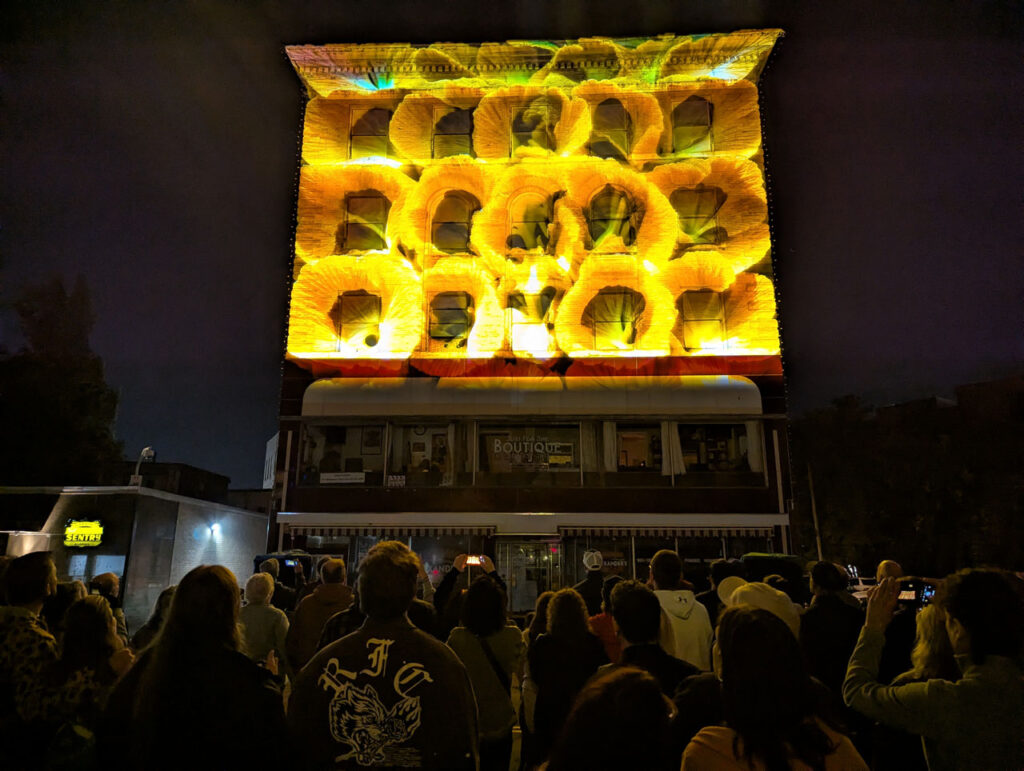
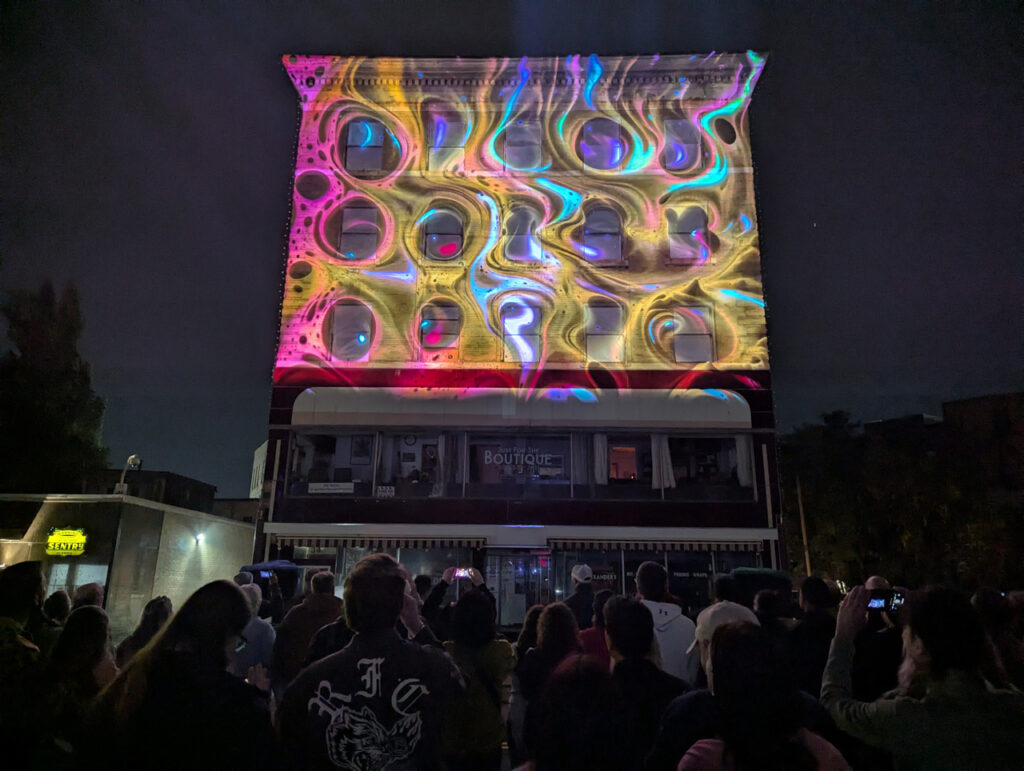
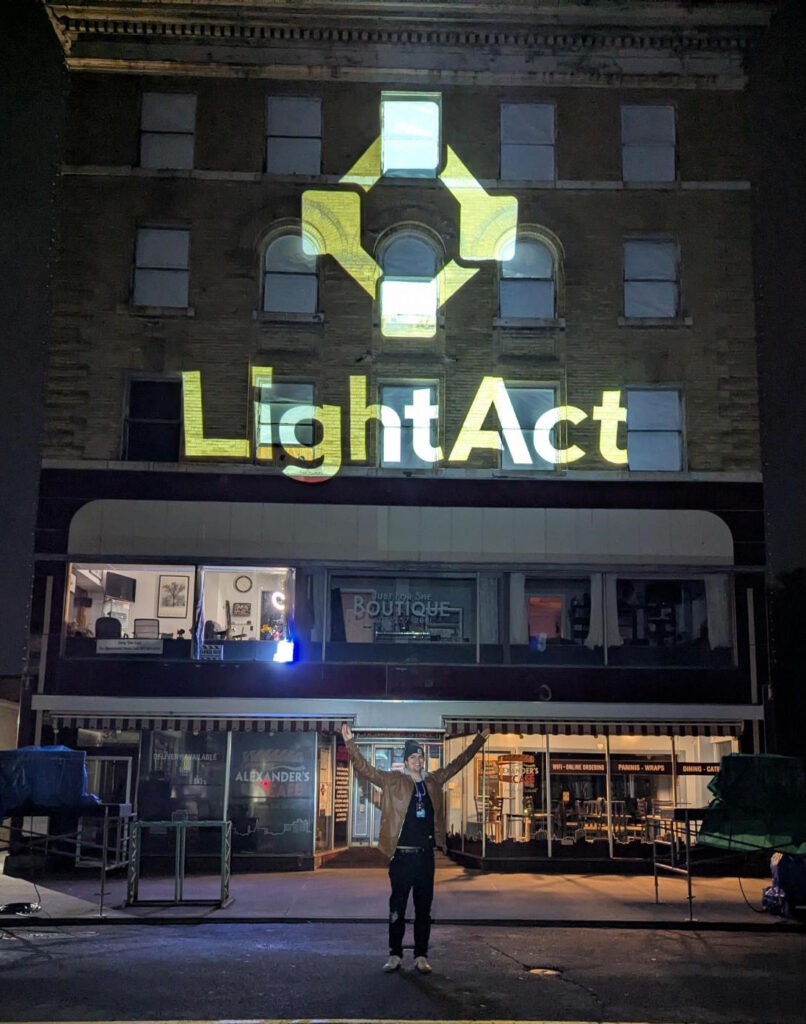
Crystal: We’ve been a proud supporter of the LUMA Projection Arts Festival for about seven years. When they approached us a few months ago looking to add an additional projection piece but lacking the necessary crew and equipment, we saw a perfect opportunity to showcase LightAct. We dedicated a LightAct server and our expertise to setting up the new projection site on 34 Chenango Street in Binghamton, New York. Our specialist, Connor, took on the programming, which was a great chance to use the software in a live public environment.

Connor Wright: I found the LightAct interface to be simplistic and genuinely enjoyable to work with. A particularly rewarding part was seeing the reaction of local college students who are looking toward this industry. They were excited to see the software in action and impressed with how smoothly and intuitively the interface worked for a large-scale projection mapping show.

"Overall, the process was super easy and very fast."

Connor Wright

Show Sage

The students were actually peeking above your shoulder while you were working?

Crystal: Yes, they were! We actually arranged a special interview with students from the regional chapter of USITT. They came into the booth for several minutes and watched a few runs of the show while Connor walked them through how he had accomplished the projection mapping.

Connor: Exactly. While the show was running, I was showing them the software interface, and they were asking a lot of great questions. They seemed really excited about the future opportunities that the software presents in the industry.

Crystal: And just to clarify the scale, this was a massive projection. We were mapping onto a building that was about six stories tall, projecting across four or five of those stories. It was a really big canvas.

In the software you used a single video screen and then created sub-areas and applied warp and softedge, right?

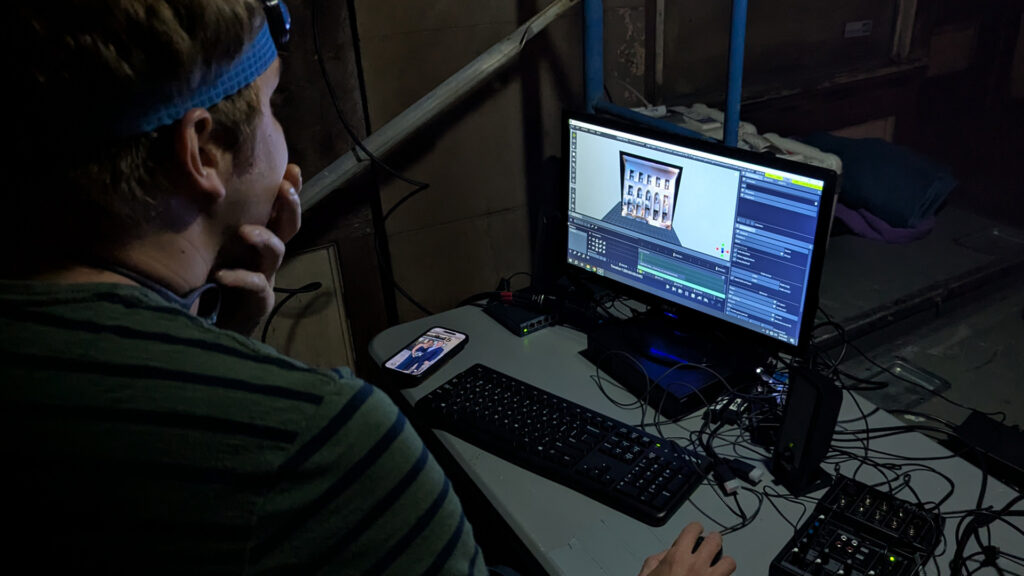
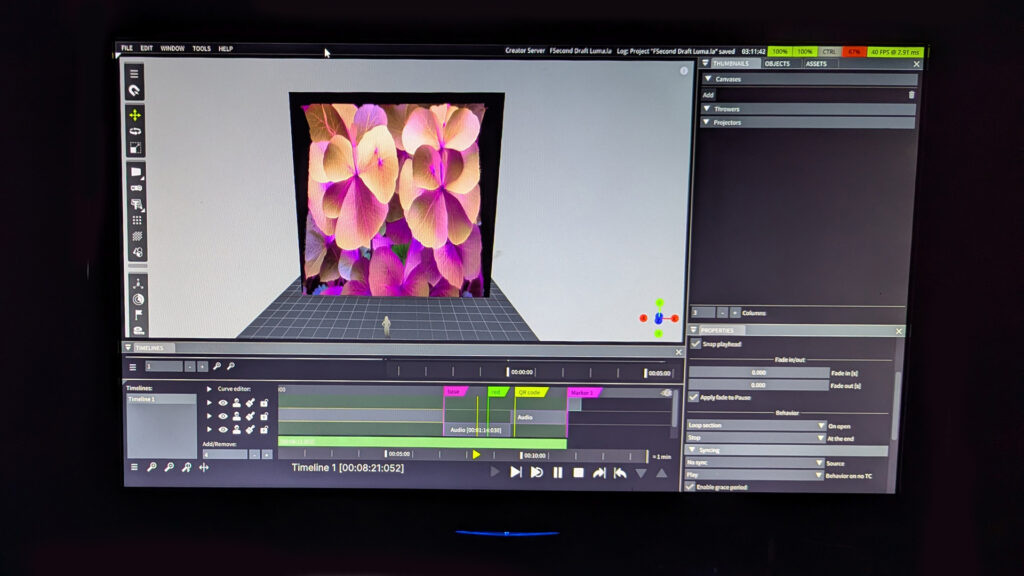
Connor: Yeah, the setup was quite straightforward. I used one Video Screen in the software to represent the front of the building. We then created two sub-areas within that screen and blended them together using the nodes.

It was very simple. I was able to quickly add a little soft edge blending to the bottom, which was a specific request from the client. Overall, the process was super easy and very fast.

Big Shows, Fast Workflows

Interview with Mech Creative

We sat down with Jakub, Gwidon and Szymon from Mech Creative to talk about their studio, their work, emerging trends and technologies they encounter and their experience in switching to LightAct as their main media server platform.

It was a lot of fun and very informative!

"LightAct is an easy-to-use software."

Jakub Czarnik

Mech Creative

Can you say a few words about your studio and how you started?

Gwidon Wydrzyński: We started the studio with Szymon a few years ago. To be honest, I don’t actually recall the exact year.

Szymon Płotkowski: I believe it was 2018, and we began under a different brand. However, three or four years ago, we rebranded to Mech Creative.

Gwidon: In the beginning it was just the two of us with Szymon, but in 2020 Jakub joined our company and he’s now one of the key people in the company.

How did the three of you get involved in the live events?

Gwidon: We all came into live events through different routes. I personally come from the theater.

Jakub Czarnik: I was practically born into the industry. My father is one of the distributors in the Polish market. So, you could say I started quite early – I made my first cuelist when I was four!

Szymon: As for me, I started as a technician at a large Polish company, working on festivals, television shows, and the like. Then I moved to Green Beam Design and worked there for about three years. It was at one of the festivals we did that I met Gwidon, and that’s how we started.

Gwidon: Yes, it started in a really weird way actually, but we can’t talk about that. Let’s just say that the party was rough! (laughs)

"Having a software-only option was really useful for some smaller concerts."

Szymon Płotkowski

Mech Creative

What kind of work do you do?

Gwidon: We work with all kinds of music and concerts. I personally also try to stay involved with theaters. We handle events too, like the Night Embassy event for Jägermeister in Poland. For that, we transformed several spaces within the Palace of Culture and Science in Warsaw to create a club-like atmosphere. 

Szymon: To be honest, we haven’t cut anything out from the work we did before we started with Mech Creative. I still work for television, and Jakub is also a consultant to several manufacturers of lighting fixtures. We operate as Mech Creative, but at the same time, we continue all the work we’ve done previously.

Jakub: Exactly. We continue all our past work but as Mech Creative, we tackle festivals, events, and concerts spanning all genres—from electronic to hip-hop, pop, and rock. Basically, everything you can imagine.

Szymon: Because we want to have as much say as possible in the visuals of our projects. So we try to assist with multimedia, production, scenography, and set design.

Gwidon: I think you could say we strive to be the art directors for our concerts, tours, and events.

Jakub: Yes, we even create some of the content and design some of the scenography ourselves. We don’t do it manually, of course, but we can handle it all. It depends on the project’s needs, as they vary, but we’re capable of doing everything, and we do!

You recently started using LightAct in your productions. How did you come to this decision?

Szymon: I was looking for a different way to use Notch blocks in a concert. And I was looking at the Notch site and found a list of softwares that supported Notch blocks. LightAct was of course on that list. I contacted you, you gave me a two-week license, I reprogrammed everything in LightAct, everything went well, and that’s how we started using it.

Gwidon: We like to break the walls and do something different. We like new solutions; we really love new technologies and all that stuff. I think Jakub is the best of us at developing and searching for new technologies and finding answers to all our questions about how to do things differently.

Jakub: Yeah, we’re looking for the right tools for a job, let’s say. So, for every job, we’re looking for solutions that will fit the best. And that’s why we are here with LightAct as well.

"We love that we can get direct support from LightAct technicians."

Gwidon Wydrzyński

Mech Creative

You’ve been using LightAct for 2 years now. How do you like it so far?

Jakub: We’ve done quite a few shows with LightAct over the past two years. Last year, we used it for Oki’s tour. At the beginning of this year, we worked on the Genzie tour. We also finished a show with Kuban at Torwar hall in Warsaw using it. It went quite smoothly; LightAct is an easy-to-use software.

The node-based layers are incredibly intuitive for us because we build exactly what we need. At the same time, we don’t end up with eight universes of layers in our lighting console if we have simple needs for a show. Sometimes we just need a dimmer and the play state of a layer, and that’s it. Other times, we need a lot of functions, and LightAct gives us the flexibility to use all of them.

Szymon: And of course, we used a dedicated server for some productions, but there was a day when we had two concerts, and one of them was run on one of our computers. So, having the possibility to do that is also a good thing.

"The node-based layers are incredibly intuitive for us because we can build exactly what we need."

Jakub Czarnik

Mech Creative

What I noticed is that you are very independent. You do all these shows and there is not a single support request coming from you. How did you manage to achieve that?

Szymon: That’s also because we’re quite busy!

Gwidon: Yes, but you know, support is something we appreciate very much. We love to be in touch with technicians and get support directly from the producer of the software.

Jakub: It’s always good to talk with the people who actually make the software, unlike some other companies where a feature request just goes nowhere. That’s a nice thing. Every time we have any needs, I just drop you a message on Discord, and it’s usually solved quite fast. It depends on the idea, but all the things we need are in the software right now, so we’re happy with it.

What do you see as an emerging trend?

Szymon: I’m not sure if you want to hear this, but we’re seeing a return to analog scenography, with LED screens potentially integrated within it. All the augmented reality and virtual reality stuff? I think that’s becoming a thing of the past.

Gwidon: Yes, actually, you’re right. That’s a challenging question for us!

Jakub: It’s not bad, though, because I think content is becoming much more interactive with the whole scene and scenery. That’s the direction I believe everything is heading. Internationally, you see many shows using tracking of kinetic trusses and similar elements, which are integrated with LED screens and their content. I think that’s a really cool direction.

Gwidon: Yes, that’s a really cool way. But I guess those are actually the two main popular directions things are going in.

Jakub: I think they can be merged together.

Szymon: Perhaps we should distinguish between the Polish market and the world market. On the Polish market, we’re finding that big LED screens are becoming boring, and people are tired of them. Meanwhile, globally, you have massive screens, like for Adele’s concerts in Munich last year. But in Poland, we’re increasingly using physical sets, with less content and fewer LED screens. I think we’re getting back to a balance, because for the last few years, it was unbalanced, with too many LED screens.

Gwidon: Yes, every concert was about the visuals and the big LED screens in the back. But in Poland, there’s often no money for developing technologies to do things like in the international market, as Jakub mentioned—reactive content with kinetics and similar elements. There are no budgets for that, even on big tours or festival tours.

Jakub: I think time is what’s missing.

Gwidon: Time and budget, I guess. It’s super time-consuming.

Szymon: We’re ready to implement tracking in our shows, but there hasn’t been an event with the budget and time to actually use LightAct for tracking.

Jakub: So, that’s the issue we’re facing right now. If we have a show with some kind of budget that allows us to use creative stuff like kinetics, we often don’t have the time to actually integrate it with generative content that can use data from any system. That’s the issue. For MÄ™skie Granie, for instance, we get final tracks a week before the festival starts, and we need to produce all the content and program video and lighting in that week. It’s a nightmare.

Gwidon: Yes, it’s really hard stuff to do. So, it’s about the money, about the time. 

That’s the Polish market. Welcome.

Big Shows, Fast Workflows